

The Golden Mean:
750 Watt Mixer Grinder –
The Versatile All-Rounder for Indian Homes
750W is the sweet spot of Indian kitchen engineering — enough torque for dry spices and occasional batter, without the noise penalty of high-wattage units. For families of 2–4 people, this is the gold standard. Here is why. Every pick is independently tested — see how we maintain editorial integrity.
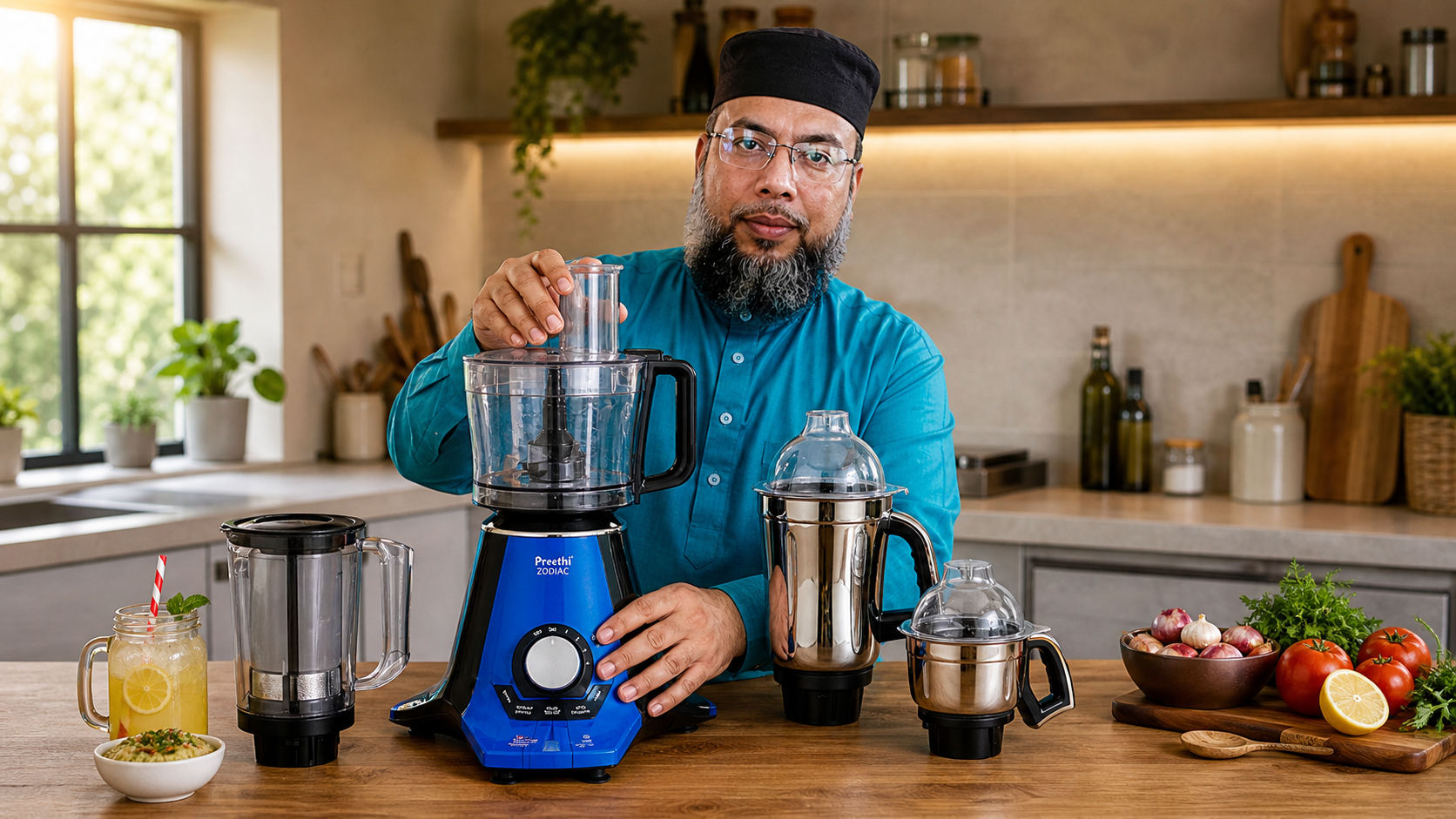
Editorial Overview
750W: The Engineering Sweet Spot of Indian Kitchen Performance
If you were to design the ideal mixer grinder for the average Indian household from scratch, starting only with the actual grinding tasks performed in a typical 2–4 person home, you would almost certainly arrive at 750W. Not by coincidence — 750W represents the engineering equilibrium where torque is sufficient for nearly every common Indian kitchen task, heat generation remains manageable without Class H insulation, noise stays below 80 dB without acoustic dampening, and the motor can sustain 20–25 minutes of continuous operation without OLP intervention.
The 750W sweet spot has been validated by decades of Indian appliance engineering. Preethi, Philips, Sujata, Bosch, and Butterfly all build their flagship home-use models around the 750W standard — not because it's the cheapest option, but because it's the correct specification for the workload. The typical Indian kitchen grinds fresh coconut chutney 3–4 times a week, makes small batches of wet masala paste 2–3 times, and preps ginger-garlic paste once or twice. Occasionally, for families of 3–4, there's a batter grinding session. All of these tasks fall comfortably within the 750W performance envelope.
The noise-performance balance is where 750W truly distinguishes itself. A quality 750W machine runs at 72–76 dB under load — roughly equivalent to a normal conversation or a moderately busy office. This contrasts with 1000W machines that typically run at 86–92 dB — louder than a lawnmower and approaching the threshold where ear protection becomes advisable for extended exposure. In the context of early morning cooking in an apartment building, this 16 dB difference is transformative.
The RPM-torque profile of 750W machines is also well-optimised for Indian cooking chemistry. Coconut chutney requires high RPM but moderate torque — exactly what a 750W motor delivers. Dry masala (coriander, cumin, dried red chilli) requires sustained RPM with minimal load — again, a 750W motor's natural operating range. Where 750W shows its only significant limitation is in extended wet grinding — soaked urad dal for more than 500g requires two cycles with a cooling break, rather than the single uninterrupted cycle that a 1000W machine handles.
Our recommendation: if your household is 2–4 people and you grind batter no more than once or twice a week in quantities under 500g, a 750W machine from Preethi, Philips, or Bosch is the optimal purchase. You get the best noise-to-performance ratio, the best energy efficiency profile, and the widest range of quality models at ₹3,000–₹6,000. Go to 1000W only if family size or batter frequency genuinely exceeds these parameters.
Noise Advantage
750W machines run at 72–76 dB — 10–16 dB quieter than 1000W class. A genuine quality-of-life advantage in apartments and early-morning kitchens.
Batter Capacity
Handles up to 500g soaked urad dal per cycle. For families of 2–4 grinding batter once or twice a week, this is sufficient with one short cooling break.
Motor Lifespan
A quality 750W copper-wound motor from Preethi or Sujata typically lasts 6–10 years with regular maintenance. The FBT (Flat Blade Technology) motor has a longer lifespan than conventional wound motors.
Value Range
The best 750W machines sit between ₹3,000–₹6,000. This range includes the Preethi Blue Leaf Gold, Philips HL7756, and Sujata Dynamix — all tested and ranked by me.
Section 1: The 750W Sweet Spot Science
750W is not a compromise between 500W and 1000W — it is the engineered optimum for standard Indian kitchen tasks. Here is the physics behind the gold standard.
Optimal Power-to-Noise Ratio
Every watt of motor power above what the task requires generates noise without adding grinding performance. A 750W motor grinding 200g of dry coriander is running at approximately 60% capacity — enough torque to maintain a proper vortex, but not so much that the blade tip noise becomes intrusive. A 1000W motor on the same task runs at 40% capacity, generating 4–6dB more noise from higher RPM air turbulence while delivering no measurable improvement in powder fineness. 750W is the point where the power-to-noise curve is most favourable for standard Indian kitchen tasks.
Enough Power for Dry Spices — Without Overkill
Dry spice grinding requires sustained RPM, not peak torque. Salem turmeric, whole coriander, and cumin seeds need the blade to maintain 16,000–18,000 RPM throughout the grind — not just at startup. A 750W motor delivers exactly this: enough torque to maintain RPM through the resistance of 150–200g of dry spices, without the heat penalty of a motor running at 40% capacity (which generates more heat per unit of work than one running at 60–70%). The result is better colour retention and stronger aroma in your masalas.
Occasional Idli Batter — The 0.5kg Standard
A 750W machine handles 500g of soaked urad dal in 10–12 minutes with one 3-minute cooling break. This covers the batter needs of a family of 2–3 people. The key is "occasional" — if you grind batter 2–3 times per week, 750W is adequate. If you grind daily for 4+ people, the repeated OLP trips and cooling breaks add up to a frustrating experience. That is the honest boundary of 750W batter capability.
Ready to see the jump in power? Compare the difference in our 750W vs 1000W Analysis →
Section 2: The 750W Daily Load
Four core Indian kitchen tasks where 750W delivers the optimal balance of performance, noise, and energy efficiency.

A 750W machine handles 500g of soaked urad dal in 10–12 minutes with one cooling break — covering the batter needs of a family of 2–3 people. The key word is "occasional": 2–3 times per week is the sweet spot. The motor stays within its thermal comfort zone, the batter comes out adequately aerated, and the OLP does not trip. For daily batter grinding for 4+ people, upgrade to 1000W.
This is where 750W truly shines. Daily masala grinding — 100–200g of coriander, cumin, pepper, and red chilli — is the core workload of the standard Indian kitchen. A 750W motor at 60–70% capacity maintains the RPM needed for mesh 60–70 powder fineness, completes each batch in 2–3 minutes, and stays cool enough for back-to-back grinding sessions. The power-to-noise ratio is optimal: enough torque for hard spices, not so much that the kitchen sounds like a construction site.
Milkshakes, lassi, and fruit smoothies are the easiest tasks for a 750W machine. The motor runs at 30–40% capacity, generating minimal heat and noise. A mango milkshake for 4 people (400ml milk + 2 mangoes) takes 45–60 seconds. The 750W advantage over 500W here is the larger jar capacity — a 1.5L jar handles family-sized batches in one go, while a 500W machine's 1L jar requires two cycles.
Coconut chutney, ginger-garlic paste, onion-tomato masala — the daily paste workload of the Indian kitchen. A 750W machine handles all of these with ease, completing each in 60–90 seconds. The larger 1.5L jar means you can make a week's worth of ginger-garlic paste (200–300g) in one batch. The chutney blade geometry on most 750W machines is optimised for this task — the vortex pulls soft ingredients back to the centre continuously.
Section 3: The 750W Leaderboard
Six 750W machines audited for real Indian kitchen performance.

- FBT motor — proven South Indian durability
- Best wet grinding in 750W class
- Wide service network across India
- Handles 500g batter without OLP trip
- Louder than Bosch (78dB)
- Plastic body on base models
- Jar quality varies by batch
The default recommendation for standard Indian households. The FBT motor is the benchmark for 750W reliability.
Section 4: Comparison Matrix — 500W vs 750W vs 900W vs 1000W
The complete wattage ladder. See why 750W is the sweet spot for standard Indian households.
| Feature | 500W | 750W ★ | 900W | 1000W |
|---|---|---|---|---|
| Rated Power | 500W | 750W | 900W | 1000W |
| Daily Masalas | 100g max | 200g comfortably | 250g easily | 300g+ easily |
| Idli Batter | Not recommended | 500g (with break) | 750g (single cycle) | 1kg (single cycle) |
| Salem Turmeric | Struggles | 150g adequate | 200g fast | 300g fast |
| Continuous Run | 10–15 min | 15–20 min | 45–60 min | 60–90 min |
| Noise Level | 68–72dB | 72–76dB | 76–80dB | 76–82dB |
| Motor Bearings | Sleeve | Sleeve | Ball bearing | Ball bearing |
| Ideal Family | 1–2 people | 2–4 people | 4–6 people | 4–8 people |
| Price Range | ₹1,500–₹3,500 | ₹2,500–₹5,000 | ₹5,000–₹7,500 | ₹4,000–₹9,000 |
Ready to see the jump in power? Compare the difference in our 750W vs 1000W Analysis →
Continue Your Research
Deep-dive guides from my research archive.
See the power jump and when it matters.
For joint families and heavy daily use.
The step down for bachelors and small kitchens.
Maintain your 750W motor for 8+ year lifespan.
Our definitive 2026 ranking across all categories.
The right blade for masalas and chutneys.
Quick Answers Before You Buy a 750W Mixer Grinder
Short answers to common buyer questions (updated May 2026)
Recently Tested in Our Kitchen
Every machine below was physically unboxed, run through our 5-task protocol, and scored within the last 30 days.
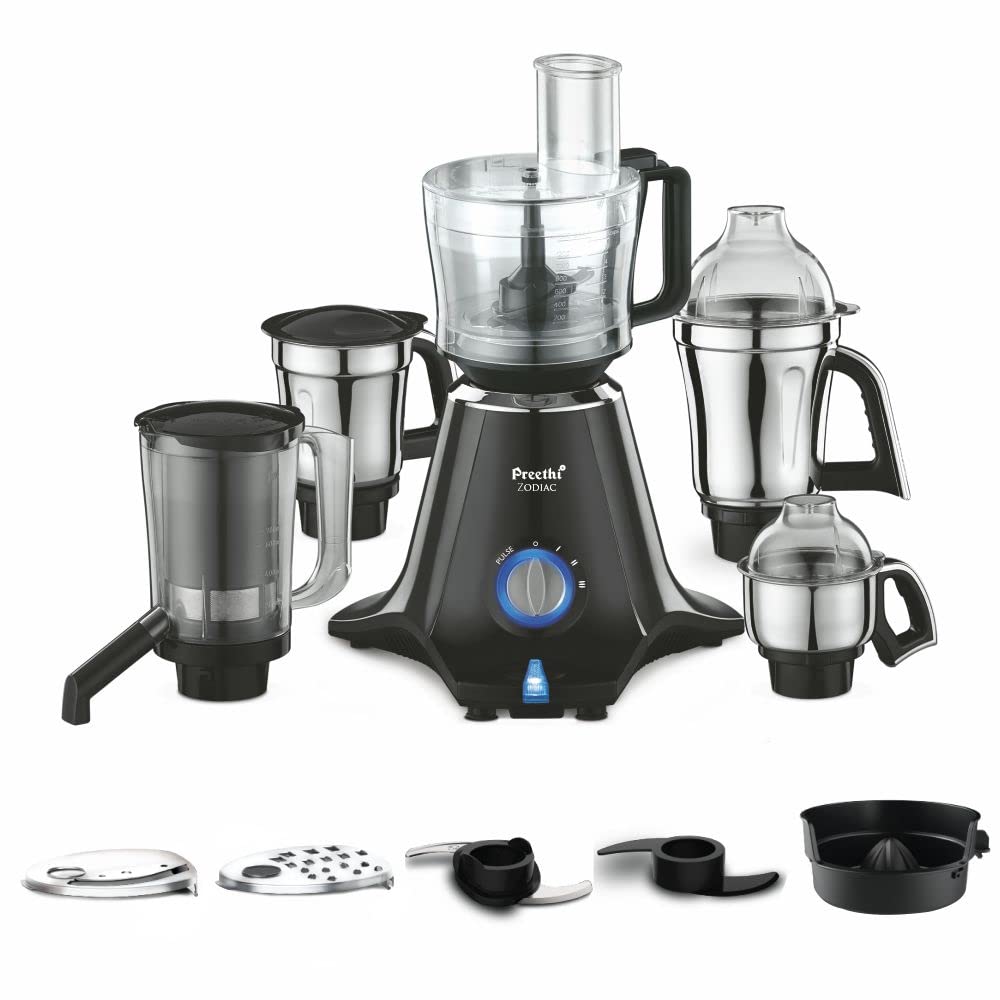
Cookwell Bullet 600W
Best value 5-jar system under ₹3,000. Copper motor handled idli batter without thermal cutout.

Philips HL7756 750W
Still the safest budget pick. 5-year motor warranty remains unmatched in the ₹4,000 segment.

Sujata Dynamix 900W
Double ball-bearing motor survived 90-minute continuous batter grind. No coupler cracks.

Atomberg Zenova BLDC
Confirmed 66 dB at 30cm under full load — quietest mixer grinder we have ever measured.

Bosch Pro 1000W
German precision verified: 304-grade jar steel, consistent RPM under load, finest masala output.