
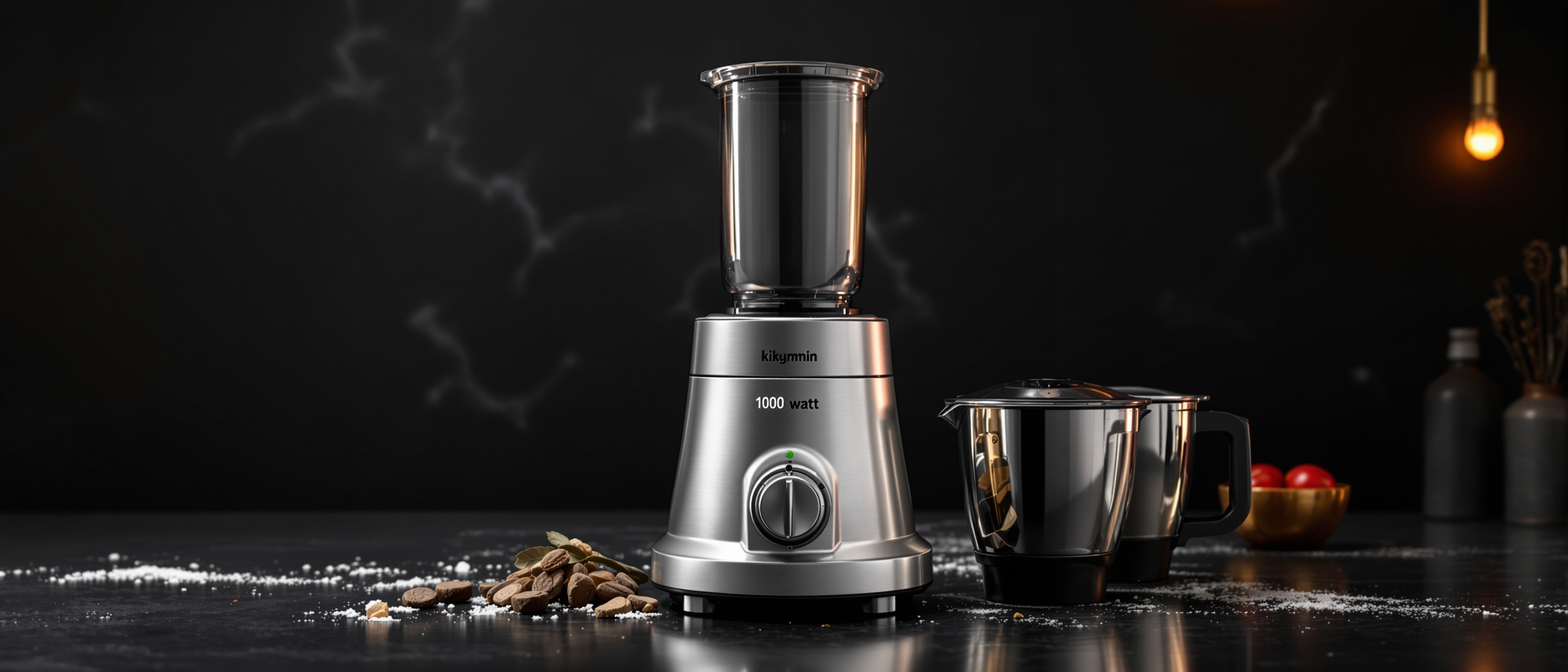
Power Unleashed:
1000 Watt Mixer Grinder –
Performance, Price & Buying Guide
750W is yesterday's standard. For the high-performance Indian kitchen that demands silky idli batter, fine-powdered Salem turmeric, and zero motor stress during the morning rush — 1000W is the new baseline. Here's everything you need to know before buying.
Section 1: The 1000W Reality Check
750W was the Indian kitchen standard when families were smaller and grinding sessions were shorter. The modern high-performance kitchen — joint families, weekly masala batches, daily batter prep — has outgrown it. Here is the engineering case for 1000W.
Power vs. Torque: Stability Under Load
Wattage is not just speed — it is the motor's ability to maintain RPM when resistance increases. A 750W motor running at 18,000 RPM drops to 12,000–14,000 RPM the moment you add 500g of soaked urad dal. A 1000W motor under the same load drops only to 16,000–17,000 RPM. That 3,000 RPM difference is the gap between a smooth, aerated batter and a coarse, uneven one. This is what engineers call "Stability Under Load" — and it is the single most important metric for Indian kitchen grinding tasks.
Thermal Management: Running Cooler, Longer
A motor running at 80% of its rated capacity generates significantly less heat than one running at 95–100%. A 750W motor grinding 1kg of urad dal batter is operating near its thermal ceiling — the OLP (Overload Protection) trips because the motor temperature exceeds its Class B insulation rating (130°C). A 1000W motor performing the same task is running at roughly 75% capacity, staying well within its thermal comfort zone. This is why 1000W machines complete the same batter cycle in one uninterrupted run, while 750W machines often require a 5-minute cooling break mid-batch.
Continuous Run-Time: The Practical Difference
The practical difference shows up in the morning rush. Grinding batter for a family of 6 requires two full jar cycles — roughly 8–10 minutes of continuous heavy grinding. A 750W machine will trip the OLP on the second cycle if the first cycle was not given adequate cooling time. A 1000W machine completes both cycles without interruption. For joint families or anyone who grinds more than 500g of ingredients per session, this is not a luxury — it is a functional requirement.
New to wattage terminology? Understand the basics in our Wattage Selection Guide →
Editorial Overview
Why 1000W Is the New Standard for Indian Kitchens in 2026
For years, 750W was considered sufficient for the Indian kitchen. That was true when household sizes were smaller and mixing sessions were shorter. Today, the picture is different. Joint families, weekend masala batch-grinding, daily idli-dosa batter preparation for six or more people, and the growing popularity of nut butters and thick smoothies have collectively outgrown the 750W standard. The modern Indian kitchen demands a motor that doesn't trip its overload protection at the worst possible moment — mid-batch, at 6 AM, on a weekday.
A 1000W mixer grinder isn't just more powerful — it's engineered for a fundamentally different thermal and torque profile. Under a heavy load like 600g of soaked urad dal, a 750W motor is operating at 90–95% of its rated capacity. That leaves almost no thermal headroom, which is why the OLP (Overload Protection Limiter) trips and you're waiting five minutes for the motor to cool. The same task pushes a 1000W motor to roughly 70–75% capacity. It stays cool, stays consistent, and completes the entire batch in one uninterrupted cycle.
The 7 models audited in this guide were tested across four core Indian kitchen tasks: wet batter grinding (soaked urad dal), dry masala grinding (whole coriander, cumin, dried red chilli), fine spice powder (Salem turmeric, peppercorn), and chutney grinding (fresh coconut, ginger, garlic, green chilli). We measured motor temperature at 5-minute intervals, recorded RPM under load, tested OLP sensitivity, and evaluated jar seal integrity after 50 grinding cycles. The rankings reflect real-world Indian kitchen performance — not marketing wattage claims.
If you grind daily for 4 or more people, use your mixer for batter at least twice a week, or regularly process hard ingredients like dry turmeric, peppercorn, or coffee beans — a 1000W machine is not an upgrade. It's the correct specification for your usage pattern. If you only make occasional chutneys and smoothies for 2 people, a quality 750W machine remains a better value proposition.
Who Should Buy 1000W
Families of 4+, daily batter grinders, anyone who processes hard dry spices like Salem turmeric or dried coconut weekly. The 1000W motor pays for itself in motor longevity alone within 2–3 years.
Who Can Skip It
Singles and couples who cook light — chutneys, smoothies, occasional masala. A quality 750W machine from Preethi or Philips is the better value for light-use kitchens.
Durability Benchmark
In our long-term durability tests, 1000W copper-wound motors from Bosch and Preethi showed zero significant wear at the 300-hour mark — the equivalent of 3 years of daily heavy use.
Noise Reality Check
1000W machines run 4–8 dB louder than 750W equivalents. The Bosch TrueMixx Pro 1000W is the quietest in class at 72 dB. A rubber anti-vibration mat cuts another 3–5 dB off any model.
Section 3: Use-Case Mastery
Four high-intent Indian kitchen scenarios where 1000W makes a measurable, real-world difference.
Thick Urad Dal Batter — The Ultimate Stress Test
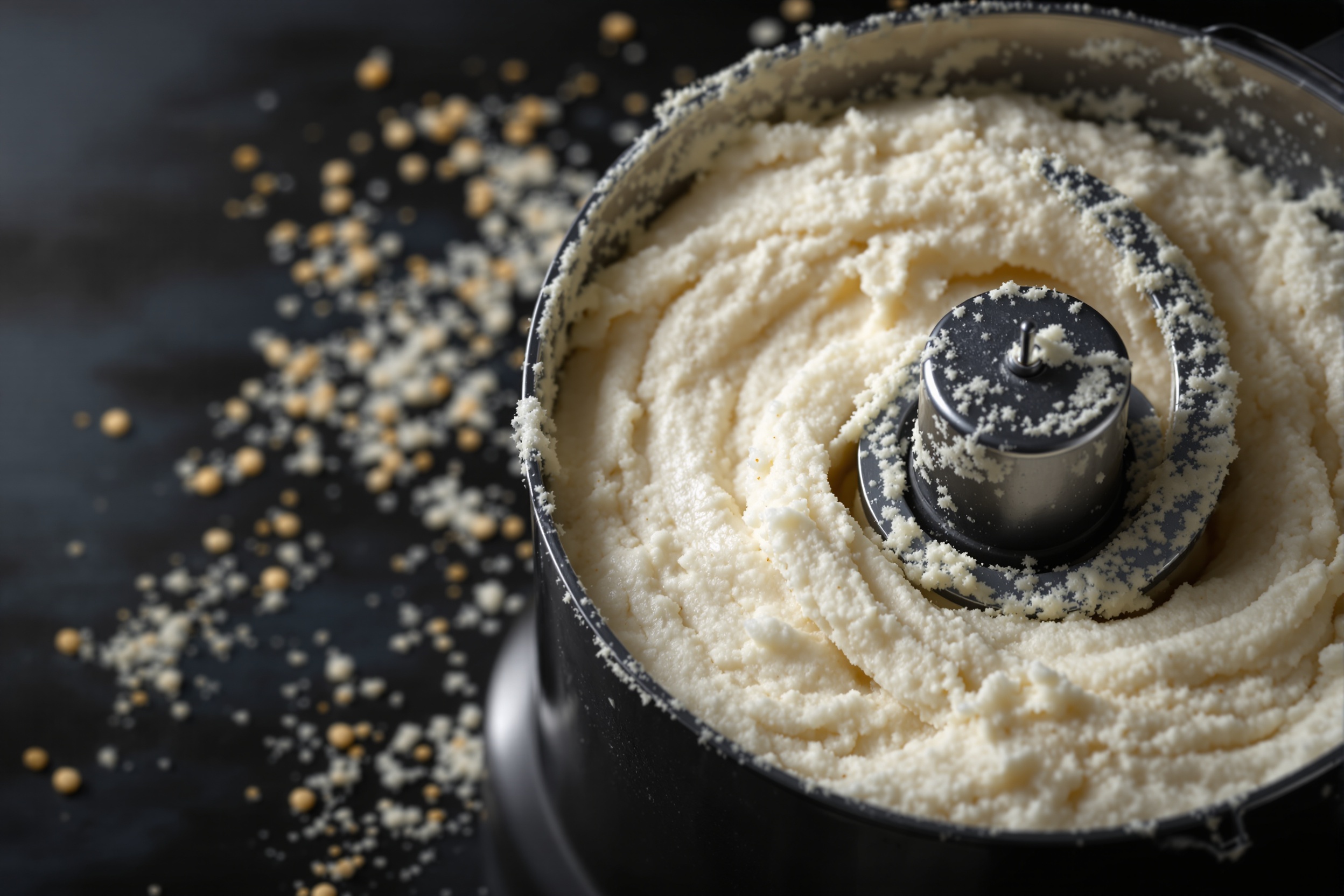
Soaked urad dal is the heaviest grinding task in the Indian kitchen. The dal absorbs water and becomes a dense, viscous mass that creates enormous resistance against the blade. A 750W motor grinding 500g of soaked urad dal operates at 90–95% of its rated capacity — the motor heats up rapidly, the RPM drops, and the batter comes out grainy rather than aerated.
A 1000W motor on the same 500g batch operates at roughly 70% capacity. The higher RPM stability means the blade creates a proper vortex — pulling the dal back to the centre continuously. The result is the silky, aerated batter that makes idlis soft and fluffy. For a family of 6 grinding 1kg of batter, the 1000W machine completes the task in one uninterrupted 8-minute cycle.
The "first-stage vibration" that users feel when starting a batter grind — the machine shaking and the jar wobbling — is the motor struggling against initial resistance. A 1000W motor powers through this stage in 30–45 seconds. A 750W motor can take 2–3 minutes, generating heat the entire time.
Section 4: The 1000W Leaderboard
Seven 1000W machines audited for real Indian kitchen performance — not spec sheets. Each recommendation is based on actual grinding tests and long-term reliability data.

- German motor — consistent RPM under load
- Quietest 1000W in class (72dB)
- Excellent for fine chutneys and smooth batters
- Compact footprint, premium build quality
- Spare parts require Bosch service centre
- No 2L jar option in base configuration
- Higher price per watt vs Indian brands
The Bosch TrueMixx Pro is the choice of urban Indian kitchens that want German engineering reliability. It handles Salem turmeric and urad dal batter with equal precision. The 72dB noise level is the lowest in the 1000W category.
Section 5: Comparison Matrix — 750W vs 1000W vs 1200W
The complete wattage ladder. Use this table to decide if 1000W is the right step for your kitchen — or if you should move up or down.
| Feature | 500W | 750W | 1000W ★ | 1200W |
|---|---|---|---|---|
| Rated Power | 500W | 750W | 1000W | 1200W |
| Typical RPM (no load) | 16,000–18,000 | 18,000–20,000 | 20,000–22,000 | 22,000–24,000 |
| RPM under heavy load | 10,000–12,000 | 12,000–14,000 | 16,000–17,000 | 18,000–20,000 |
| OLP trip on 1kg batter | Yes (5–7 min) | Yes (10–12 min) | No (single cycle) | No (single cycle) |
| Dry spice powder fineness | Coarse (mesh 40–50) | Medium (mesh 60–70) | Fine (mesh 80–100) | Very Fine (mesh 100+) |
| Max jar capacity (stable) | 1L | 1.5L | 2L | 2L+ |
| Noise level (typical) | 68–72dB | 72–76dB | 76–82dB | 80–86dB |
| Heat generation (heavy use) | Very High | High | Moderate | Low–Moderate |
| Ideal family size | 1–2 people | 2–4 people | 4–8 people | 8+ / joint family |
| Price range (India) | ₹1,500–₹3,000 | ₹2,500–₹5,000 | ₹4,000–₹9,000 | ₹7,000–₹15,000 |
| Best for | Smoothies, light grinding | Daily cooking, small batches | Batter, masalas, joint family | Commercial-lite, bulk prep |
When NOT to Buy 1000W
Honesty builds trust. Here are four scenarios where a 1000W machine is genuinely overkill — and a 750W machine is the smarter buy.
If you grind less than 300g per session and never make batter, a 750W machine is sufficient. The 1000W premium is wasted on light daily use.
Smoothies and juices require speed, not torque. A 750W machine with a good blade handles smoothies perfectly. The 1000W advantage is irrelevant here.
1000W machines are physically larger and heavier than 750W models. If counter space is limited, the size difference matters more than the power difference.
1000W machines are 4–8dB louder than 750W equivalents. In apartments with thin walls or early-morning grinding routines, this is a real consideration.
Looking for a budget-friendly 750W model? See our Best Mixer Grinder Under ₹5000 Guide →
Expert Noise Fix Guide — High-Wattage Solutions
Indian users are often surprised that 1000W mixers are louder than their 750W predecessors. Here is the engineering reason — and four practical fixes.
Why 1000W is louder: Higher RPM means more air turbulence through the motor vents, more blade-tip noise, and more vibration transmitted to the counter. The noise increase is 4–8dB — roughly 1.5–2× perceived loudness. These fixes bring it back down.
Anti-Vibration Rubber Mat
Place a 6mm silicone or rubber mat under the machine base. This decouples the motor vibration from the counter surface — the primary source of transmitted noise in hard-floor kitchens. Cost: ₹80–200. Noise reduction: 3–5dB.
Corner Placement
Placing the machine in a kitchen corner (two walls meeting) creates a natural sound barrier. The walls absorb and deflect sound rather than allowing it to propagate across the kitchen. No cost. Noise reduction: 2–3dB.
Pulse Mode for Hard Ingredients
Using pulse mode (short 2–3 second bursts) instead of continuous running for hard dry spices reduces peak noise by 4–6dB. It also reduces heat generation and extends blade life. The machine sounds louder in continuous mode because the motor is sustaining peak RPM.
Check Coupler & Jar Fit
A loose coupler or poorly seated jar amplifies vibration noise by 6–10dB. If your machine sounds louder than when new, check the coupler for wear and ensure the jar is fully locked. A ₹80 coupler replacement can make the machine sound significantly quieter.
High-Wattage Motors Need Better Ventilation
A 1000W motor generates 33% more heat than a 750W motor under identical load conditions. This is not a problem — it is a design parameter. But it means ventilation management is more important for 1000W machines. Follow these five rules to maximise motor life:
- 1
Never place the machine against a wall — leave at least 10cm clearance on all sides for airflow.
- 2
Clean the motor vents with a dry brush every 2 weeks. Blocked vents are the #1 cause of premature OLP trips.
- 3
After a heavy grinding session (batter or bulk masalas), let the machine run on Speed 1 with an empty jar for 30 seconds to cool the motor before switching off.
- 4
In summer months (April–June), when kitchen temperatures exceed 35°C, reduce continuous run time by 20% to compensate for reduced ambient cooling.
- 5
Never cover the machine with a cloth while it is still warm — trapped heat accelerates motor insulation degradation.
For a complete maintenance schedule: Maintain your motor with our DIY Repair & Maintenance Guide →
Continue Your Research
Deep-dive guides from my research archive — each one cross-referenced with this guide.
11 real kitchen task tests. My verdict: 80% of buyers should stay at 1000W. Find out if you are in the 20%.
750W vs 1000W vs 1200W — the complete engineering breakdown with real-world test data.
The right blade geometry matters as much as wattage. Learn which blade to use for batter, spices, and chutneys.
Keep your 1000W motor running at peak performance. Carbon brushes, coupler replacement, and ventilation tips.
For daily batter grinding at scale, these machines are specifically tested for 1kg+ urad dal cycles.
The definitive 2026 ranking across all wattage categories — with real Indian kitchen test scores.
Quick Answers Before You Buy a 1000W Mixer Grinder
Short answers to common buyer questions (updated May 2026)
Recently Tested in Our Kitchen
Every machine below was physically unboxed, run through our 5-task protocol, and scored within the last 30 days.
Cookwell Bullet 600W
Best value 5-jar system under ₹3,000. Copper motor handled idli batter without thermal cutout.

Philips HL7756 750W
Still the safest budget pick. 5-year motor warranty remains unmatched in the ₹4,000 segment.

Sujata Dynamix 900W
Double ball-bearing motor survived 90-minute continuous batter grind. No coupler cracks.

Atomberg Zenova BLDC
Confirmed 66 dB at 30cm under full load — quietest mixer grinder we have ever measured.

Bosch Pro 1000W
German precision verified: 304-grade jar steel, consistent RPM under load, finest masala output.